We all know the saying: "Sometimes less is more." It resonates deeply with me, but it took me years to understand why.
I have a default setting: over-responsibility, especially with loved ones. I tend to think about their needs before they do. I plan for them. I try to predict what they want, often before they are even aware of it themselves.
I used to think this was helpful. I thought it was leadership. I thought it was love.
But I realized it is often a trap. When you fill every silence, the other person never has to speak. When you solve every problem before it fully manifests, they never build the muscle to solve it themselves.
The dynamic becomes unbalanced. If the "give and take" ratio skews heavily toward my giving, I don't receive what I need in return. Worse, the people I love get used to the service but forget the person behind it. You become a utility, not a partner. You risk being perceived as "just a nice guy," rather than a man with his own gravity.
The solution wasn't to do more. It was to do less. Subtraction.
By stepping back, I gave others space to step forward. By doing less, I gave them room to think about me, to value the contribution, and—perhaps most importantly—to miss me.
We see the same pattern in our business.
Just as we over-function in our relationships to manage anxiety, we over-function in our companies to manage market panic.
We are told the world is changing. We see the headlines promising trillions in AI value. And our instinct is to add.
-
Add more pilots.
-
Add more data governance.
-
Add more "innovation" meetings.
We think that if we do more, we will be safe.
But look at the results. As I wrote in my latest article, 80% of AI projects never reach production. Most companies are drowning in "Goal Fog"—vague objectives like "improve efficiency" that sound nice but mean nothing. You are trapped in the "Mushy Middle," inching forward with tiny, safe projects that don't move the needle.
Real strategy is not the art of addition. Real strategy is the art of subtraction.
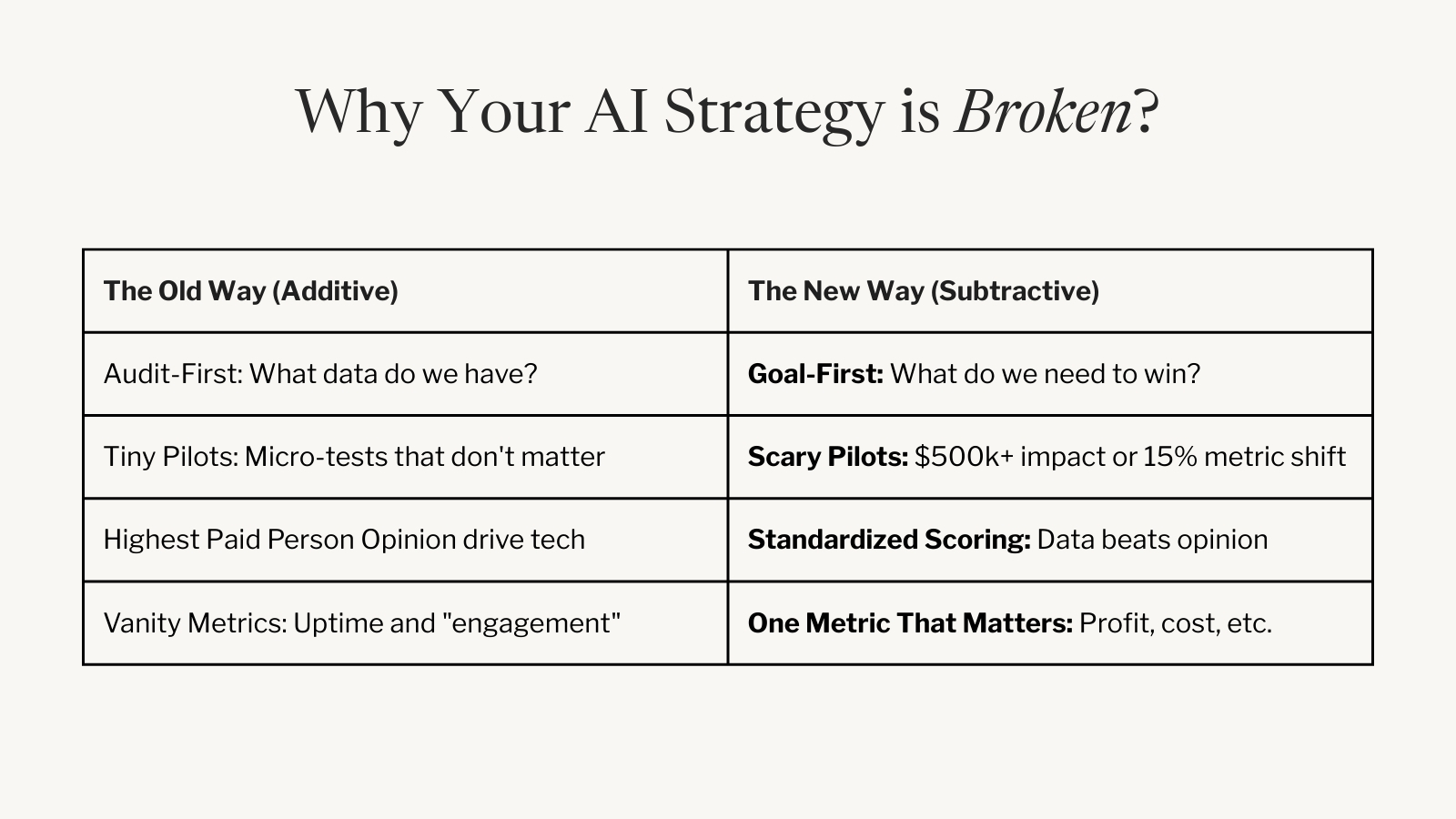
It requires the Courage to review a backlog of 100 AI ideas and eliminate 90 of them. It requires the Calm to ignore the "HiPPO" (Highest-Paid Person's Opinion) when they demand a chatbot simply because they saw one at a conference. It requires the Clarity to measure One Metric That Matters, rather than a dashboard of twenty vanity metrics.
Subtraction is scary. It feels like you are doing less work. But in reality, you are doing the only work that matters.
Whether in love or in business, doing more, saying more, and writing more is rarely the answer. The win comes from the space you create, not the noise you generate.
Your move.
Start subtracting.
Read the full breakdown of the Subtractive Strategy in my latest post:
Why Your AI Strategy is Broken: The Case for Subtraction.