I was thinking recently about the beautiful journey of building a family from a romantic relationship.
It's an adventure filled with discovery. Yes, there are twists and turns, but that's what makes it real. You bring different strengths to the table. You carry stories from your past that shaped who you are. You navigate the sweet chaos of daily life together.
When you spend your days "auditing" love, scanning for flaws or measuring what's missing, you start living under a microscope. Everything feels heavier than it is. And you forget the best part: you're not here to manage a mess. You're here to build something beautiful together.
But there's an even more powerful approach.
You can time-travel. Close your eyes and imagine the home you want to live in two years from now. Visualize the holidays glowing with warmth, the deep connection you share, the spontaneous kisses and hugs. See yourselves exploring the world together, moments of peace and joy. Hear the music. Loud laughter. The adventure.
Once you see that future clearly, you open your eyes and work backward. You ask an empowering question. Not "What's holding us back?" but "What can we build today to make that beautiful future?"
Suddenly, challenges become stepping stones on your path to those dreams. Your different personalities aren't obstacles, only complementary strengths that enrich and make your shared home more interesting.
I realized this is exactly why most AI strategies fail.
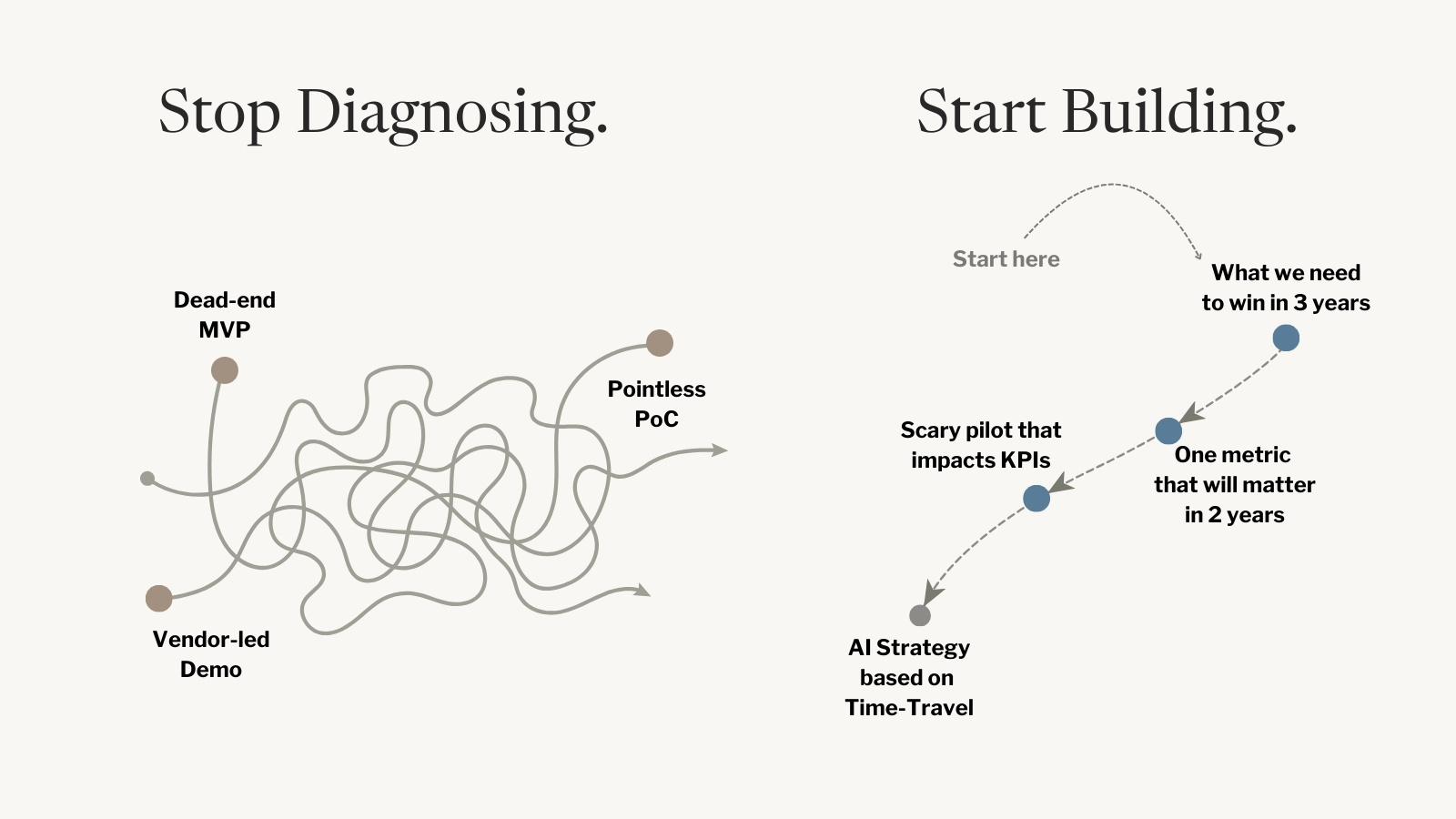
Look at the image above.
Most executives plan their AI strategy the way unhappy couples plan their relationship: by diagnosing the present.
The Diagnosis Trap (Present-Forward)
They look at the current body of the organization—the messy data lakes, the legacy IT stacks, the budget constraints—and they ask: "Based on the symptoms and tools we have today, what can we treat?"
They audit. They diagnose. They tinker. This leads to the "Audit-First" trap shown on the left of the graphic. You build a chatbot for HR FAQs because the data was clean (easy diagnosis), not because it changed your P&L. You get stuck in the loop of "Vendor-led Demos," hoping a tool will cure a problem you haven't defined.
To win, you must stop diagnosing your current limitations and start building your future reality.
The Builder's Arc (Future-Back)
Real strategy requires "Future-Back" thinking (the right side of the graphic).
We do not start with today's mess. We ignore the diagnosis completely. Instead, we time-travel 3 years into the future to a state where you have already won.
Step 1: The Blueprint (3 Years Out) Define the victory. Just like the "happy home," what does the winning company look like? "We have automated 90% of our underwriting process," or "We predict customer churn with 95% accuracy 48 hours before it happens."
Step 2: The One Metric That Matters (2 Years Out) Now, follow the dotted line backward. For that victory to be real in Year 3, what specific number must have moved in Year 2? This is your compass. If a project doesn't move this number, it is noise. Kill it.
Step 3: The Scary Pilot (Today) Now, arrive back at today. To hit that metric in Year 2, what must you build now? It won't be a trivial chatbot. It will be a "Scary Pilot"—a project that targets a core operational bottleneck. It will require data you don't have yet (which forces you to build the right pipeline, not just a pipeline).
The Shift
-
Diagnosing asks: "What can we do with what we have?"
-
Building asks: "What must we create to get what we want?"
Whether you are building a family or an enterprise, the mechanism is the same. The left side of the graphic is comfortable, but it is a dead end. The right side is frightening, but it is a straight line to the life—and the business—you want.
Stop diagnosing the present. Start building the future.
Your move.
Read the full playbook for turning this into an execution plan:
Building AI Strategy Part 3: Run to Win.