Why Your AI Strategy is Broken: The Case for Subtraction.
Jan 11, 2026
The global marketplace is currently hallucinating.
You see it in the headlines promising trillions in economic value. You hear it in boardrooms where panic masquerades as planning. You are told to innovate immediately. You are told to automate everything. You are bombarded with the message that if you don't implement GenAI by Q2, you will be obsolete by Q4.
Yet, the reality on the ground is different.
Statistics paint a grim picture: 80% of AI projects never reach production (RAND), and 30% are cancelled just after PoC (Gartner). Of the few that do, most fail to deliver results that a CFO would recognize. They languish in the "Mushy Middle"—a zone of mediocrity where companies deploy safe, microscopic pilots that change nothing.
The problem is not the technology. The LLMs work fine. The problem is your strategy.
Most companies plan by looking at today's mess—their legacy stacks, their dirty data, their siloed teams—and inching forward. They operate in an Additive mindset, piling new tools on top of broken processes. They choose projects that cannot fail because they are too small to matter.
You are drowning in "Goal Fog." Vague objectives like "improving efficiency" or "empowering our workforce" are death sentences. Your roadmaps are PowerPoint fantasies that ignore the messy reality of your data swamps.
It is time to stop.
Real strategy is the Art of Subtraction. It is the discipline to review a backlog of 100 "innovative ideas" and eliminate 90 of them. It is the realization that "more AI" usually just means "more noise."
To win in this era, you don't need another vendor demo. You need a manifesto. You need a new operating system for decision-making.
The Contrarian Pledge
If you are an executive tired of the hype cycle, this is your new baseline. Before we write a single line of code, we take this pledge:
I will not pilot for the sake of piloting.
I will choose the frightening project over the trivial one.
I will kill the noise of vendor demos and HiPPO whims.
I will start from the victory and work backward.
I will run to win, or I will not run at all.
The Great Reset: From Additive to Subtractive
How do we turn that pledge into action? We have to fundamentally invert how we build strategy. We have to move from the Old Way (Additive)—which is safe, slow, and crowded—to the New Way (Subtractive).
Based on the patterns I see in failing organizations versus the few that are dominating, this shift comes down to four specific pivot points.
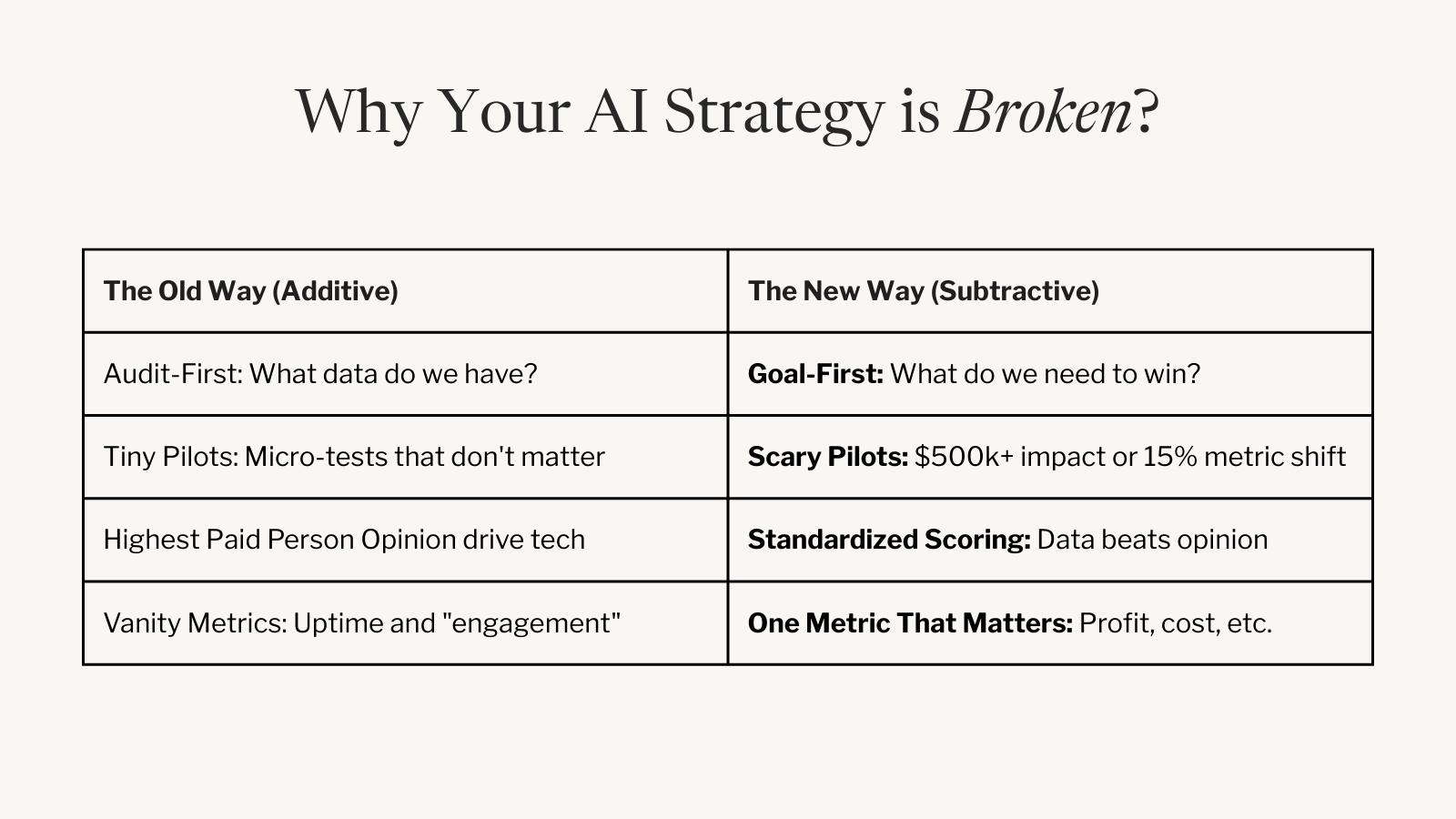
1. Stop asking "What data do we have?" (Audit-First vs. Goal-First)
The Old Way: The traditional IT approach is Audit-First. You look at your data warehouses, lakes, and spreadsheets and ask: "What data do we have, and what can we build with it?"
This sounds logical, but it is a trap. It anchors your future strategy to your past failures. If your data is messy (and it always is), your strategy will be messy. You end up building low-value tools simply because "the data was available."
The New Way: The Contrarian Executive ignores the current state of the data. Instead, you operate Goal-First.
This is what I call "Time-Travel." You mentally transport yourself three years into the future—to a state where you have already won. You define the victory clearly (e.g., "We have automated 90% of claims processing").
Only then do you work backward. You ask: "To achieve this victory, what data do we need?"
You don't build a data lake; you build a specific data pipeline for a specific victory. You stop acting like a librarian archiving old records and start acting like an architect building a new foundation.
2. Kill the "Safe" Pilot (Tiny Pilots vs. Scary Pilots)
The Old Way: The "Mushy Middle" is filled with tiny pilots. A department head reads an article and demands a chatbot for HR FAQs. It costs $20k, takes 3 months, and if it fails, no one notices.
This is corporate tourism. It proves that technology works (we know it works), but it proves nothing about business value. Tiny pilots breed complacency. They allow you to say you are "doing AI" without ever risking your reputation or your budget.
The New Way: If your AI project doesn't make you slightly nauseous, it's not worth doing. You need Scary Pilots.
A "Scary Pilot" is defined by impact. It must target a $500k+ outcome or a 15% shift in a core metric. It targets the critical path of your business—the legacy underwriting logic, the core logistics routing, the customer acquisition engine.
Why choose the scary project? Because these are the only projects with enough gravity to force organizational change. A tiny pilot can be ignored by IT and Operations. A scary pilot demands that the best people in the room solve the problem. High risk is the only path to high leverage.
3. Silence the HiPPO (Opinion vs. Standardized Scoring)
The Old Way: The biggest threat to your AI strategy is the HiPPO (Highest Paid Person's Opinion).
The CEO returns from a conference in Davos or Vegas, excited about a new tool they saw on stage. Suddenly, the entire engineering team pivots to build a solution, even though there is no problem to solve. This is "Noise." It creates a roadmap based on hierarchy rather than value.
The New Way: Real strategy requires the courage to say "No," even to the CEO. But you can't say "No" based on your opinion. You must say "No" based on data.
You need Standardized Scoring. Every potential use case—whether it comes from a junior dev or the Board of Directors—must fight for its life against a rigid "Kill Criteria."
-
Does it solve a $1M problem?
-
Do we have the "Future-Back" data requirements?
-
Is there a path to production in 90 days?
If the answer is no, the project dies. Data beats opinion. By ruthlessly killing 90% of projects that are noise, you free up the resources to double down on the 10% that are Signal.
4. Delete the Dashboard (Vanity Metrics vs. One Metric That Matters)
The Old Way: Companies love complex dashboards. They track "Model Uptime," "Monthly Active Users," "Chatbot Engagement Rates," and "Accuracy Scores."
These are Vanity Metrics. You can have 99.9% uptime and high engagement on a tool that is hemorrhaging money. You can have a highly accurate model that predicts customer churn, but if no one acts on that prediction, the value is zero.
The New Way: Identify the One Metric That Matters (OMTM).
This metric should be boring. It should be financial or operational.
-
Profit: Net margin impact per unit.
-
Cost: Cost per resolved ticket (not just "ticket deflection").
-
Velocity: Time to quote.
When you run your AI strategy, you focus on this single number. If it isn't moving, you aren't winning. You don't need a dashboard of 20 green lights; you need a single compass pointing North.
Courage, Calm, Clarity
Transitioning from Additive to Subtractive is not easy. It feels unnatural to do less when the market is screaming at you to do more.
It takes Courage to kill the zombie projects cluttering your portfolio. It requires Calm to ignore vendor hype and competitors' FOMO. It requires Clarity to align 10,000 employees behind a single, frighteningly ambitious goal.
But this is the only way out of the Mushy Middle.
Stop building generic AI strategies. Stop chasing the algorithm of the week.
Start killing the noise. It is time to time-travel to your future victory, and then work backward to today.
Your move.