Who Is Paid to Kill Your AI Projects?
Jul 14, 2026
Four forces keep inflating your portfolio. Boards need an explicit mandate to subtract.
I have sat on almost every side of the AI table.
Executive. Vendor. Adviser.
The vocabulary changes. The incentives do not.
Projects enter easily. They almost never leave.
Your AI portfolio is not just a roadmap. It is a pressure vessel. Every quarter, someone pumps in another pilot, platform, use case, workstream, or strategic option. The pressure rises. Attention fragments. Accountability thins out.
Then everyone wonders why AI produces activity without impact.
Nobody needs to lie for this to happen. Nobody needs to act in bad faith. Each actor can behave rationally.
The system still inflates.
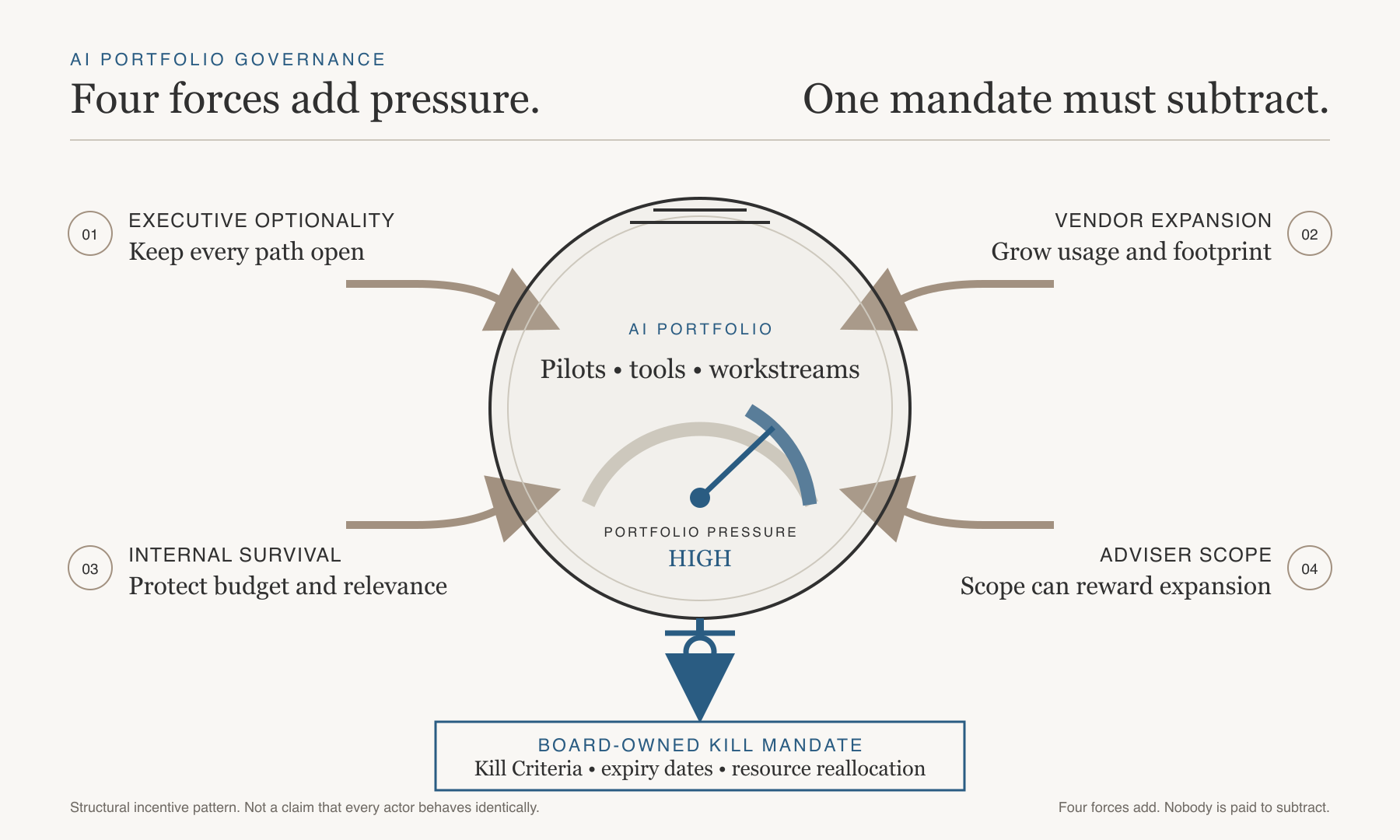
Four rational forces. One irrational outcome.
1. Executives preserve optionality
Uncertainty makes options feel valuable.
When nobody knows which AI capability will matter in twelve months, running ten pilots can look more prudent than choosing two. No executive wants to kill the initiative that a competitor later turns into an advantage.
So the portfolio grows.
Each new pilot buys a little political safety. It shows movement. It keeps several sponsors satisfied. It postpones the uncomfortable moment when leadership must choose one future and close the others.
But options are not free. They consume money, data, engineering time, management attention, and organizational trust.
A portfolio without expiry dates is not optionality.
It is avoidance.
2. Vendors expand their footprint
Technology vendors may care deeply about your results. Their commercial system still measures expansion.
More seats. More usage. More workloads. More products inside your architecture.
That is not a moral failure. It is how the model works.
A vendor demo answers one question well: Can this technology do something impressive?
It rarely answers the harder question: Should this become one of the few capabilities your company commits to owning?
Even Google's vendor-sponsored ROI of AI research shows where the hard work sits. Change management, data quality, and skills rank ahead of deploying more agents as investment priorities.
The tool is rarely the whole constraint.
3. Internal teams protect relevance
An initiative creates more than a deliverable. It creates a sponsor, a budget, a team, a reporting line, and a story about why that team matters.
Killing the initiative threatens all five.
This is why weak projects acquire surprisingly strong immune systems. The longer they survive, the more people become attached to their continuation. Sunk cost turns into identity. Activity turns into evidence of importance.
Most governance gives someone responsibility for starting.
Far less often does it reward someone for stopping.
The result is pilot purgatory. Board of Innovation describes the same leadership gap in its AI Fluency Playbook: scattered experiments keep moving because no one has enough authority to kill the noise.
4. Advisers can benefit from the scope
Advisers are often asked to diagnose complexity while being paid to work inside it.
More analysis, more workstreams, more specialists, and longer transformation programmes can all be defensible. They can also increase fees.
That tension does not prove dishonesty. It proves that engagement design matters.
Some advisers fight the pressure well. McKinsey's 2026 AI Transformation Manifesto explicitly argues against long use-case lists. It recommends concentrating transformation in one to three business domains and a few economic leverage points.
Good. That is serious counterevidence to the lazy claim that every large consultancy always wants more.
But a methodology is not a commercial model.
If fees rise with people, weeks, and scope, subtraction must fight the contract. A strong adviser can still recommend less. Your governance should not assume the economics make that easy.
This is a conflict of incentives, not a conspiracy.
The missing job
Most AI portfolios have sponsors, product owners, architects, programme managers, risk leads, and steering committees.
Who owns the kill decision?
Not who is allowed to stop a failing project after six red reports. Who is expected to remove work before failure becomes undeniable?
That role is often empty.
The cost appears to exceed the budget. A 2026 McKinsey survey of 750 employees and leaders found that organizational readiness explained nearly twice as much variation in reported value capture as personal readiness. Enterprise value did not come from giving more people more tools. It stemmed from changes in workflows, roles, resource allocation, and leadership behaviour.
Those changes require choices.
You cannot concentrate talent while funding every experiment. You cannot redesign a critical workflow while ten minor pilots compete for the same data engineers. You cannot create accountability when every initiative remains strategically important.
Focus is not a communication exercise.
It is the discipline to disappoint someone on purpose.
Install a relief valve
Boards do not need to select individual models. They need to make subtraction legitimate.
Every material AI initiative should face the same Subtraction Test:
- What economic or operational result changes if this succeeds?
- Which one of our few strategic domains does it serve?
- What evidence, by what date, earns the next round of funding?
- What existing work will we stop funding and staff properly?
- Who has the authority, incentive, and date to kill it?
If the answers are vague, you do not have a strategic bet.
You have an option dressed as a commitment.
The fifth question changes the system. It gives the portfolio a relief valve. It makes stopping a designed outcome rather than a career-ending admission.
This is where Kill Criteria matter. Define them before the demo, before the favourite vendor, and before a senior sponsor falls in love. Give every initiative an expiry date. Report capital and talent released, not only milestones completed.
The person holding the kill mandate should not be rewarded for the number of projects terminated. That would create a new distortion. Reward the quality of reallocation. Did scarce talent move to the few bets that matter? Did decision latency fall? Did one economic metric improve?
Subtraction is not austerity.
It is a commitment.
Make pressure visible
At your next portfolio review, do not ask only what started, what shipped, and what turned green.
Ask what should no longer exist.
Then ask which of the four forces is keeping it alive.
The goal is not a small portfolio because small is beautiful. The goal is a concentrated portfolio where every bet has weight, an owner, an economic purpose, and a reason to survive the next gate.
AI strategy is not the courage to start.
It is the courage to stop.
Who is paid to kill your AI projects?
If the answer is nobody, you already know why the pressure keeps rising.
Your AI portfolio will not shrink by itself.
I turned this argument into a one-page instrument: the AI Project Kill Scorecard. Score each initiative on the three questions that matter, and let anything below the line defend itself or die.
Your move.